Showing posts with label Beginner. Show all posts

Friday, February 17, 2017

Four Beginner Mistakes and How to Avoid Them

"In the beginner's mind there are many possibilities, but in the expert's there are few."
-Shunryu Suzuki 

I was playing in a tournament recently and was watching some of the games in the U1000 section. Most of the players had just started playing that year and it was good to see their enthusiasm and competitive spirit. It was also a special tournament for me because my own children started their chess journey and played in the unrated section for their first tournament.

As I watched their games, I began to notice a few common types of mistakes the players were making in their games. I've been there too. In this article, we'll discuss a few of the prominent ones I noticed and how to avoid them.

Ignoring Your Opponent's Moves

The tell-tale sign of this was seeing the player's hand make a move and press the clock and then hover over the next piece he plans on moving (often the same one he just moved). All of this without even looking at his opponent's side of the board. 

Remember in chess that it takes two to tango. Chess is a very interesting art because not only do you use your own creative powers along with your logic and reasoning, your opponent does as well. In fact, his creative and reasoning ability is focused on plans and intentions diametrically opposed to yours! We just can't ignore what he's doing or capable of doing.

Here is one of the positions I saw.


This is an extreme example but it is not an uncommon one for beginners to make.

Our next example comes from a more conventional middlegame position. In this case, Black sees the simple threat of an under-defended piece and makes a move to resolve the situation. However, she ignores (or doesn't see) the potential tactical shot.


Often times, when beginners make these mistakes they often kick themselves, because it is not necessarily a concept that they don't understand, but usually a move they did not see.

In the example above, if Black was given the position in from White's point of view and told that it was White to "Move and Win" she would have seen the fork in less than 10 seconds. However, because Black isn't in the habit of considering her opponent's responses, it wasn't a part of her decision making process.

How can we fix this mistake? First, I think a lot of experience will help naturally as players will start to come up with ways to avoid simple mistakes lest they continue to lose because of them.. I think we can accelerate the process though by being aware of it and taking action. Here are a few ideas:

  • Follow Blumenfeld's Rule: Before you make your next move, as yourself, "Am I allowing mate in one? Am I allowing my queen to get taken? Am I allowing my rook to get taken?" and so on. Although this may seem like it takes a lot of time, it will become automatic and it will save a lot of heartache as you avoid dropping those queens!
  • When studying master games or going through your own games, identify the attack and defense relationships between the pieces. For example, when you move a piece, identify what pieces are attacked by it or defended by it. This will help you develop your awareness.
  • Practice checkmate problems. Although I primarily use Chess Tempo and Chessity for tactics training, I really like Ideachess for its ability to select checkmate problems from two-movers to four-movers. Start with two-movers and move on to mates-in-three. Doing these will develop your board vision as you will need to know how each piece works to checkmate or defend the opposing king.

Lone Wolf Pieces

The second thing I noticed was that the players were often sending in one (maybe two) pieces to attack a target.

Sometimes this might be in the opening when a player gets his knight or queen out, and then tries to probe for weaknesses that just don't appear. Or they see a piece that's en prise so they attack it, only for it to be defended on the next move.

Here are a few tips to cure this particular issue:

  • Remember to develop your pieces in the opening before starting an attack. I discuss this topic more fully in my article on learning opening moves.
  • When you decide to attack a target, think about your opponent's response and how you will follow-up to the initial defense. See if you can build up an attack on a single target.
  • Make sure that all of your pieces are participating in the game. When you're not sure what to do, ask yourself, "Which of my pieces are not doing anything yet?" Find something for it to do.
  • Study the games of the great masters for examples of how players coordinate their pieces. See the Morphy game I have included below.
Here is an example of planning ahead and building up pressure on a simple target using the example of an isolated pawn.

One of the great Paul Morphy's skills was using all of his pieces to conduct an attack. Here he demonstrates this ability in fine fashion against Spanish-Cuban master Celso Golmayo. You can also check out my video on this game.


There are times when one must "go it alone." However, your chess pieces in general shouldn't!

Lacking Basic Endgame Knowledge

There are many reasons why studying the endgame is very useful for beginners.
  • Endgame positions involved fewer pieces and thus are simpler to learn.
  • Endgame knowledge transfers to other parts of the game.
  • Since many beginners (and intermediate players) neglect the endgame, your knowledge of the endgame will give you a competitive advantage.
Here was the ending of a game that was painful for everyone to watch. Both players were rated around 600.


In the beginning, you don't need to know that many concepts and specific endgames. However, the following are useful and very common at all levels:

  • Queen and King versus King (shown above)
  • Rook and King versus King
  • Two Rooks and King versus King
  • King and Pawn versus King
  • Understanding the concept of the opposition
  • Understanding the "square" of the pawn.
You can study these in Jeremy Silman's very useful Silman's Complete Endgame Course. For overall chess training, including a comprehensive endgame course, I also recommend GM Nigel Davies' Tiger Chess program.

Missing Opportunities

The final beginner mistake I will discuss today is missing opportunities. Specifically, in this tournament I saw a lot of missed mates-in-one and hanging pieces. In a way, this is the opposite of the first mistake. Instead of ignoring your opponent's threats, you are ignoring your own opportunities. 

Here is a game I saw between two beginners in their first tournament.


There may be many reasons for this. For example, one side may overvalue the threats of their opponent (like we saw above). However, I think a lot of this is general board awareness and being careful. The solutions are similar to what I mentioned above:

  • Follow Blumenfeld's Rule for offense: "Can I checkmate my opponent? Can I take his queen? Can I take his rook?"
  • Before making a move, ask yourself, "Can I find a better move?"
  • Study basic tactics problems on Chessity or from a book like Chess Tactics for Students by John Bain.
  • Study checkmate problems on Ideachess or from a book like the massive Chess: 5334 Problems, Combinations, and Games by Laszlo Polgar (father of the famous Polgar sisters).

Enjoying the Journey

I hope this article provided some useful advice. I think the first step to improvement is awareness that you need to improve. The second step is to take action towards that improvement. I hope you find the tips and suggestions I provided helpful for you.

It was a joy to watch my children play in their first tournament, and I remember the pain I felt when I lost because of a "silly" mistake. With continued study and experience, you'll avoid these common mistakes. Until then, keep playing and enjoying this beautiful game of ours.

Your Turn

Did you enjoy this article?

If you are a beginner, what is your biggest struggle at the moment? Put it in the comments and I'll see if I can create more articles or videos to help you get through them.


Tuesday, April 12, 2016

How to Play Chess

Learn the Royal Game

Welcome to my tutorial on how to play the game of chess. In this article, you will learn the following:

  • How to set-up the board 
  • General rules and order of play
  • How the pieces move
  • The objective of the game and how the game ends
  • How to learn more about chess

Board Set-up

Look at the diagram below:


This is the standard set-up for chess. Notice the following:
  • The right corner (from the players' point of view) is always a white (or light) square.
  • The queen and king reside on the back row (or "rank") on the middle two squares, with the queen's initial square matching her color - the White queen goes on the white square, while the Black queen goes on the black square.
  • To the outside of the king and queen are the bishops.
  • To the outside of the bishops are the knights.
  • At the corners are the rooks.
  • The pawns start on the second rank.
In this particular diagram, you can also see coordinates. We will use these to describe piece movements in what is called Algebraic Notation. This is the standard "language" to write chess moves and you can learn it in this article about chess notation on the Chess.com website.

General Rules and Order of Play

Before we learn how the pieces move, here are a few general rules.
  • The player with the white pieces goes first.
  • The players alternate turns, with each player moving one piece and then the other. You cannot "pass" or otherwise take a turn without moving a piece.
  • The game ends either by checkmate, stalemate, an agreed draw, or resignation. We will describe checkmate and stalemate below. (There are a couple other ways the game can end, such as via "three-fold repetition", but let's focus on the most common for now)

Piece Movement

Let's go over how the pieces move. Here are a couple points for you to note about all of the pieces:
  • The pieces can capture each other by landing on them and replacing them. The only exception is the king which in traditional chess cannot be captured - we'll discuss this later in this tutorial. (Here is a video about the relative value of the pieces)
  • With the exception of the knight, the pieces cannot "jump" over each other (as in checkers).
At the end of this article, we will view a famous game played by masters to see how all of these rules are put together.

The Pawn

The pawn, the humble footsoldier in the chess army, has a variety of moves it can do in certain situations. We'll cover each of them:

First Move
On its first, pawn can either move one or two spaces forward. After its first move, it can only move one space forward.


Capturing with the Pawn
Unlike the other pieces, which capture using their general movement rules, the pawn does not capture other pieces by moving forward. They capture by moving diagonally one square.

Look at the diagram below:


Note that the Black pawn on e5 can capture only the pawn on d4. It cannot capture the pawn on e4. If it were White's move, only the d4 pawn can capture the Black pawn on e5. The White e4 pawn cannot capture.

Capturing En Passant
This is a special move for the pawn in specific situations. En Passant is French for "In Passing." Here is the general rule for capturing en passant:

  • When your pawn has reached the 5th rank (rank 5 for White or rank 4 for Black using the coordinates),
  • And your opponent's adjacent pawn uses its initial move to move two squares "passing" your pawn.
  • One your next move only, you may capture the pawn landing diagonally on the square behind the pawn you captured.
Use the diagram below to move through an example demonstrating en passant (click on either the arrows or the move notation to see the pieces move.


Pawn Promotion
The humble pawn has a special move where it can be promoted to become another piece if it reaching the 8th rank. It can become a queen, rook, knight, or bishop. Check out the diagram below for examples of how this is done.
So hopefully this gives you a good idea of how to move the pawns.

The Rook

The rook can move in four directions: forward, backward, and to either side. Note the diagram below:


In this diagram, you can see:
  • The White rook (on d4) can move sideways and up and down, and can capture the pawn on d7.
  • The Black rook (on g6) can move sideways and up and down, but must cannot pass the g4 square, because its own bishop is blocking it on g3.
The rook also has a special move in tandem with the king, called "castling," which we will discuss below when we discuss how the king moves.

The Knight

The knight is perhaps the toughest piece to explain in words, but fortunately a picture makes it easy. Basically, the knight "leaps" in an "L" shape:
  • Two squares either up, down or side-to-side, then
  • One square 90 degrees in either direction.
  • The knight does not "pass" through any of the squares between it's starting square and destination square, therefore it can go "over" other pieces.
Consider the following diagram, which illustrates the movement of the knight. 


Notice that the Black knight on h6 can only get to four squares while the White knight can reach its maximum 8 squares.

The Bishop

The bishop moves diagonally. Like the rook, it can move until it either runs into one of its own pieces or it can capture another piece (and of course it can stop at any point before this).
  • Each bishop stays on the same color for the whole game.
  • Each player starts out with a bishop on the light squares and a bishop on the dark squares.

The Queen

The queen combines the powers of the rook and the bishop as she can travel up-and-down, side-to-side, and diagonally. This makes the queen the most powerful piece (in general).


The King

The king can move in any direction exactly one square. There are a couple special rules for the king:

  • The king cannot put itself in a position where it can be captured on the next move.
  • When an opposing piece attacks the king (to where it can capture it on the next move if the king is not moved), then the king is in "check" and must attempt to escape check.
  • If the king is in check and cannot escape legally, then the king has been "checkmated" and the game is over. We will cover this in more detail in the next section.

Castling
The king has a special move - typically used to get the king to safety. This move is called castling. The maneuver goes like this:

  • The king moves two squares toward either the closer rook (kingside) or the further rook (queenside).
  • The rook moves to the other side of the king.
See the following diagram:


A couple rules regarding castling:

  • You cannot castle if your king is in check.
  • You cannot castle if you have moved either the king of the rook that you want to castle with.
  • You cannot castle if the king must travel through a square that can be attacked by an opposing piece. See the diagram below.


In the diagram above, it is Black's turn to move. Black cannot castle because the king is in check from the knight.

If it were White's turn to move, White would not be able to castle because the king must pass through the f1 square, which is attacked by the Black bishop on c4.

The Objective of the Game and Ending the Game

Checkmate

The ultimate goal for every player is to checkmate your opponent's king. As mentioned in our king section earlier, checkmate occurs when:
  • The king is in check - attacked by another piece where the king would be captured if it were the opponent's turn.
  • The king cannot escape check legally.
Example #1
Consider the following diagram:


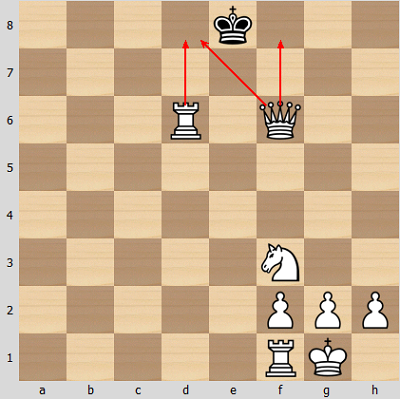
It is Black's turn to move. This position is checkmate.
  • The White queen is checking the Black king.
  • Because the queen is protected by the knight on g5, the king cannot capture the queen.
  • The king cannot go to any other square because it is either blocked by its own pieces or the square is attacked by the queen.
Example #2
Check out the diagram below:


Here is another checkmate position:
  • The rook is checking the king.
  • The king cannot go to either the c8 or e8 squares because the rook can capture it next turn.
  • The king cannot go to the c7, d7, or e7 squares because the king attacks those squares.
Example #3

Is this checkmate?


Let's see:
  • The knight on g6 is attacking the king, so the king is in check.
  • The king is blocked in by its other pieces so it cannot move.
  • The pawn on h7 cannot capture the knight because then the queen would be able to capture the king on the next move. The pawn is "pinned."
  • So yes - this is checkmate.
This particular checkmate pattern is an example of a "smothered mate." We will cover common mating patterns in another article.

Stalemate

Checkmate is not the only way to end a chess game. The game can also end in a stalemate, which is a draw. Take a look at the following position:


It is Black's turn to move. In this position we can see:
  • The Black king cannot move legally as all of its squares are covered by either the queen or the rook.
  • The Black king is not in "check" as there is no piece that can capture it on the following turn.
  • Therefore, the king is in stalemate, and the game is a draw (despite White's larger forces).
  • Note that if Black had any other pieces that could make a legal move, this would not be stalemate (and White would probably go on to win).

Insufficient Material

If both sides lack the material force needed to deliver checkmate, then the game is drawn. For example, consider the diagram below.


In this position, despite being ahead by a whole piece, this game is drawn as a lone king and knight cannot checkmate the opposing king.

Note that if the knight were a pawn it may not be drawn as White may potentially be able to promote the pawn to a piece that could deliver checkmate with the king.

Other Ways to End a Game

The game may be ended a few other ways:
  • Both players may agree to a draw in any position.
  • One player may resign - quit -  if he does not want to continue.
  • The 50 move rule: Basically, if there are 50 moves without a pawn advance or a capture, a player may claim the game drawn.
  • The three-fold repetition rule: If a game reaches the same position three times, a player may claim a draw.
  • If you are playing with chess clocks, if a player runs out of time, then the other player may claim a victory. However, if both players' time runs out without either player before someone claims, it is considered a draw if either player claims it.

Putting It Together

Here is an example of a famous game played in the 19th century. You can see how the player with the White pieces - Paul Morphy - puts the moves together to checkmate his opponent. Paul Morphy was one of the strongest players in the early years of chess. This game was known as Morphy's "Opera Game" and Paul Morphy played the duo of Count Isouard and the Duke of Brunswick.


Learning More About Chess

I hope you found this tutorial helpful. Here are a few tips on how to learn more about chess:
  • Play your friends and enjoy the beauty of chess! If you don't know anyone where you live to play check out Chess.com or the Internet Chess Club.
  • Learn algebraic notation and record the games you play for future review. 
  • Remember that both winning and losing are part of the game. Be a gracious winner and learn from your losses.
  • Check out some instructive videos. Here is three of the most instructive chess channels on Youtube.
  • Check back on this site for the growing section for beginners.

Friday, April 1, 2016

Ultimate Beginner Guide to Opening Chess Moves

How to Learn Openings as a Beginner

I have had the opportunity to teach children and adults how to play chess. It has been a joy to do so, and I have often been asked how to go about learning openings. During my classes, I often don't have time to go into detail, and often go into the commonly known general principles:
  • Control the center
  • Develop you pieces
  • Get you king to safety
However, to someone who has just learned chess this is hard to conceptualize. Searching on the internet I have found some decent resources but they either are too general, repeating these same general principles, or too specific and thus too advanced for beginning players.

So hopefully with this guide I will try to find a good middle ground so that if you've just learned how to play chess, you can find a way to navigate the opening moves of a chess game. 

I hope to do this by first giving a little more information about the general principles. Then I will actually show you some examples and show you how these principles are executed by good players. Finally I will give you some practical advice about how you can learn more as well as some resources such as books and videos you may find helpful.

The Principles of Opening Play

It is important to note that the principles are just a guideline. Sometimes you may have to break one of the principles for a specific reason. It is beyond the scope of this guide to go into too many of the exceptions but just remember this as you learn more about chess and run into an "exception to the rule."

Principle #1: Controlling the Center

Controlling the center in the opening is very important. There are a couple reasons for this:
  • When you control the center, your pieces have more room to maneuver and can coordinate better for both attack and defense.
  • Conversely, if your opponent cannot "get a piece" of the center, his or her army will have less room to move. 
What is the center?
Generally, the center are the squares d4, e4, d5, and e5. As seen here:


In practice, when both sides are fighting for the center, they will often concede some of these squares to the other in order to plan specific strategies around them. These involve lines of attack, key squares for a piece, as well as well-timed pawn breaks. I'll write more about these things at another time. In general though, against good competition, it is difficult to have full control of the center, but you want your fair share of it.

Principle #2: Develop your pieces

Besides controlling the center, your opening moves should also get your army mobilized. Usually, the pieces are developed in the following order (but again do not feel you have to stick to this if your specific game situation calls for other moves):
  • First, a pawn or two are played to place a foothold in the center.
  • Next, typically the "light" pieces - your bishops and knights - get developed next.
  • Finally, you develop your rooks (usually one of them via castling) and your queen. 
We will look at a few examples after we discuss our next principle.

Principle #3: Get your king to safety

Because the object of the game is to checkmate your opponent's king, king safety is essential. usually this is done by castling either kingside (the short way) or queenside (castling long). Modern chess theory - moves that have been tested and refined by chess master throughout the history of chess - sometimes has exceptions where it is best not to castle the king, but a majority of the major opening systems and lines of play involve castling. The reasons that castling makes the king safer include the following:
  • Since you are fighting for the center, a lot of piece activity will be happening in the middle of the board. Keeping your king in the center makes him a target of that action.
  • Typically, your pawns on the side are not moved very much in the beginning of the game, so you they can provide cover for your king.
  • Castling also develops and "connects" your rooks so they can protect each other.

The Principles in Action

Here I just want to show you how these principles play out using some popular openings. One thing to note is that at this stage, I encourage you not to try to memorize the moves, but instead try to understand the purposes behind them. As you continue your research and progress in chess, you will start to learn and commit to memory the moves you want to play.

Example #1: The Italian Game

Here is an example from a popular opening. As you continue your chess study, you will find the rich history of specific opening lines. This particular line has been played since the mid 19th century and still played by masters today!


Example #2: Queen's Gambit Declined

In our first example, we looked at an opening initiated with the King's pawn (1.e4). This next example is a popular opening starting with the queen's pawn. I think beginners should start with one of these moves with White. There are other good moves and we'll go over those as well in future articles, but for a long time, these two moves were considered the strongest for White and the strongest players in the world still use them regularly.

For more examples of these principles in action, Chess Grandmaster Alejandro Ramirez goes into a little more depth with these basic principles and how the openings developed around the basic concepts such as the center and development.


These are just a few examples for solid opening moves for White and Black to give you an idea how to apply the general principles. We will have other opening systems in future articles, and there is a lot of information in books and on the internet. This will give you a good start.


Advice on Studying Openings

Now that you know the general principles and have seen a couple examples of how chess masters throughout history have applied them, here are some next steps you can take to improve your opening play.
  • Get yourself a general book on the openings that cover a lot of the common and popular openings. As a beginner, I would not use an encyclopedic work that has moves but not much explanation. Instead, I recommend the book I used when I started studying chess: Winning Chess Openings by Yasser Seirawan. Yasser has a fun conversational style and as a former US Champion, he knows his stuff.
  • After each of your games (which you should record if possible), look up your opening in your book. See where you (or your opponent) deviated from the moves in the book and try to figure out why. 
  • In the beginning, don't worry about memorizing the moves. The basic rule is: Don't memorize a move that you don't understand. You will remember the moves more easily when you understand the purpose of each move. There are openings where it is important to understand and remember specific orders, but don't just blindly memorize.
  • If you use chess software such as Chessbase or SCID to record your games, avoid using the chess engines to analyze the opening moves. At this point in the game, the analysis generated is fairly useless for you in trying to understand the opening. The only time the engines may be useful is if you or your opponent made a big blunder that can be exploited by tactical means. Even in this case, I recommend you try to figure it out without the engine first and then let the engine check your own work. More on chess engines in another article.
  • Try different opening moves. Don't specialize too early in your chess development. First, learning different openings will expose you to many different positions and will help develop you as a player. Also, you will learn more about your own personal style and temperament as you discover which openings feel better for you. As you strengthen your overall game, you can start to study specific openings in more detail. I will write more on developing an opening repertoire.
  • Remember to study all parts of chess - not just openings. It is a dangerous trap that many beginners fall into. Studying openings can be fun, and there is the allure to "surprising" your opponent with a new opening. Don't do it! Remember to study middlegame strategy as well as endgames and practice your tactics as well. 
  • Besides using your book, you can look up whole games in specific openings with a database like Chessbase or online resources like Chess Tempo (www.chesstempo.com). It is good to study whole games played by masters to see how good players handle the positions in your opening.

Conclusion

The opening is an important phase of the game. Learning how to start your games properly will allow you to get a healthy position where you can launch attacks or defend effectively. Chess openings have a rich history and can provide aesthetic pleasure also. Come back often to learn about more common openings as well as other aspects of chess. Good luck!

Your Turn

What are your opening questions? Are there moves you don't understand? Let me know and maybe I'll create an article to answer your questions.

Wednesday, June 4, 2014

3 Key Ways to Improve Your Chess

Help! I want to get better in chess! Where do I start?

This is a question I found in a forum post recently and some of the things I find routine may not be so routine to others - particularly those who have recently decided that want to get more serious about learning chess. So in this short article I list the 3 key ways that you can improve your chess whether you are a beginner or a master!

Study Your Games


“He who knows others is wise; he who knows himself is enlightened.” ― Lao Tzu

One of the simplest ways that you can improve is by studying your own games - especially your losses. If you don't know what you're doing wrong, it is very difficult to correct it. This advice is not original, Alekhine and Botvinnik became world champions by deep analysis of their own games.

Check out this detailed article on how to get the most out of studying your games, but here are a few points you want to look for:
  • The opening: Did you follow theoretical or repertoire lines? Who deviated first? Were you ahead, even, or behind after the opening phase? How could you have improved your opening. This is where you can look up your opening in your reference books or in an online database like that found on Chess Tempo.
  • Shifts in advantage: At what point in the game did the evaluation in the position change (e.g. winning or drawn to losing or vice versa)? Why did this happen?
  • Tactical errors: Why did you miss specific tactics (e.g. was it an oversight due to distraction or lack of thought process, etc.)? Was there a new tactical motif that you didn't know before the game?
  • Any points of confusion: It is important to note any positions during the game where you were confused or didn't understand what was going on.
Once you identify these points, you should try to figure out how you should have played instead. To do this, there are several options:
  • Your own analysis: This is often very insightful, but sometimes flawed.
  • Using computer chess engines: These are very useful particularly in tactical situations, but you must be careful not to develop an dependence on them, so I recommend first doing your own analysis.
  • Stronger players or coaches: If you can find stronger players or coaches to help you analyze the games, it can be very helpful, because they can explain why certain moves are better than others.
Once you have analyzed your game and feel like you've picked up some new patterns, ideas, and knowledge, it is important to store these nuggets of wisdom for future review. I find using a computer database program such as Chessbase very helpful - I'll be creating several videos on how I do this as well as writing articles about it. However, you can also use things like notebooks with notes or creating flashcards. However, you do it, reviewing the material is very important - read my article on the 4 Dimensions of Learning for more discussion of the time factor in learning. 

For more detail on analyzing your games, check out my 4-Steps to Analyzing Your Game for Improvement.

Study from the Masters


Before I could engage my creativity, I had to learn enough of the classical theory clearly evident in the great works of art of my heroes. - Greg Allen

Just like in art, music, and sports, we learn from those who are better than we are. Fortunately, there is a rich culture of preserving the games and thoughts of the masters through the vast number of chess books (and now chess videos) available. By studying the games and theory from the masters, we stand of the shoulders of giants and gain ideas and systems that we can use in our own games.

As a little example of what I'm talking about, here is a recent position from one of my games:


The idea of 27...Qh4! is not too difficult to find. However, it is made that much easier by understanding that I had recently studied the following position from a master game (Van Wely-Giri from the Tata Steel tournament in Wijk aan Zee earlier this year):


This type of example is common once you study many master games and positions from the masters.

There is an enormous amount of literature out there, so here are some starting points for studying the masters of chess:
  • Look for annotated books or collections meant for instruction on different aspects of chess such as openings, strategy, tactics, and the endgame (for beginners, check out my foundational books for beginners).
  • Look up games or books covering your opening repertoire (although make sure the books is at your level).
  • Look up games or books by or about your favorite players. My chess took a great step up after studying Capablanca's Best Chess Endings: 60 Complete Games by Irving Chernev. 
As you study the games, positions, and ideas from the masters, it is again important to store these for future reference. My recommendation is Chessbase, but there are other database programs out there as well as the old-fashioned index card or binder (although that takes a lot of work).

Study Tactics


Chess is 99% tactics.  -  Rudolph Teichmann

This is perhaps the most frequent suggestions for improving your chess, particularly at a beginner level. This makes sense because tactics are the foundation for everything else in chess. Just like fueling and nourishing your body with food, tactical study is the nutrient rich diet for the chess player. I write a more detailed article about how to improve your tactics, but here are a few considerations to get you started:
  • Do some type of tactical training daily. It is the same as eating your vegetables and fruit. It's good for you, but better to do a little daily than a lot only once in a while.
  • Start out with simple problems. At first, you are just trying to pick up patterns that you will apply to more complex problems and in your games.
  • Find a chess tactics server on the internet and sign up. This way, you can track your progress because many of these servers have ratings for you and for the problems you do. My favorite one is Chess Tempo, partly because each of the problems have comments by other users to help you understand the problems.
  • When you get a problem wrong, don't go on to the next one, until you understand the solution.


Conclusion


Studying chess doesn't have to be a complicated thing. These three ways to improve your chess can be the foundation of your study and training program for the rest of your chess career. As with getting better at anything, although the path may be simple, it doesn't mean it is easy. Come back often to this site as I will give you advice on how to optimally implement each of these training methods. Let me know if this has been helpful to you. Best of luck in your journey and as always I wish you Better Chess!

Wednesday, May 28, 2014

What Chess Books Should I Study (for Beginners)

Chess books have been and probably always be one of the primary ways to study chess for improvement. In this article, I will discuss what are the first chess books you should study as you move from beginning chess to the intermediate level of chess. This guide will be useful for players who have just learned the game up to around USCF rating 1400. In a future post, I will discuss how to best learn from these books.


Book Selection


The selection of the right books to study is important. I remember when I was rated around 1300 and I went to a chess bookstore and the owner convinced me to buy Kasparov Versus Anand: The Inside Story of the 1995 Chess Championship Match. Not knowing any better I purchased it and eagerly started to play through the games. It only took me a couple games to realize that although the annotations were very detailed, this book was way over my head and written for a more advanced audience. Your personal chess improvement program will not only include studying books, but also playing (and analyzing your own games), and other activities like solving chess problems and maybe watching chess videos, so our goal is starting with a good foundation, and then after that is built, you can tailor the future books you study to what you need.

Principles


There are a few guiding principles that should help you find good material to study as well as a few recommendations:
  • Focus on books that have more text explanations rather than copious move variations. 
  • For now, books that are more general in nature are more useful than ones that are very focused. For example, a general book about openings is better than a book about a specific opening variation.
  • You only need one decent book in each major category of chess study (and I'll make a list below). As you progress through the books and get better at chess, your specific needs will dictate what further study materials you require to progress.

Foundational Books


With the preceding principles in mind, here is a list of books I have found helpful as I was moving from the beginner to intermediate level:
  • Game Collection/General Instruction: Logical Chess: Move By Move: Every Move Explained New Algebraic Edition by Chernev. This is a classic that explains the reasons behind every move. The games are older and illustrate a large number of fundamental principles, strategies, and tactics that are the basis of modern chess. After learning the moves of the game, this would be my recommendation on the next book to get!
  • General Opening Guide:  Winning Chess Openings (Winning Chess - Everyman Chess) by Yasser Seirawan. This book is not only comprehensive, covering many major openings, but also very enjoyable and logical to read for beginning level chess players. My general philosophy is that much of your opening study at this point should be general, and that you need to experience a lot of different types of positions and opening structures before focusing on a specific repertoire. This book will help you get that foundation.
  • Strategy: Winning Chess Strategies, revised (Winning Chess - Everyman Chess) by Yasser Seirawan. I admit I'm biased and many chess instructors recommend Jeremy Silman's The Amateur's Mind: Turning Chess Misconceptions into Chess Mastery. However, I enjoy Seirawan's writing style and easy to understand explanations of the concepts. Both books are very good and I would recommend getting one of them to start and you could always pick up the other one at a later point.
  • Tactics: Winning Chess Tactics by Yasser Seirawan. This is a very easy to understand and comprehensive look at tactics. The thing I like about Seirawan's books on strategy and tactics is that at the end of the book he has some very nice annotated games illustrating the principles that he discussed with the book featuring chess history's greatest strategists (such as Capablanca and Karpov) and tacticians (such as Tal and Kasparov). After studying this book and doing the exercises, you can go onto one of the online chess servers, such as Chess Tempo and practice your tactics.
  • Endgame: Silman's Complete Endgame Course: From Beginner To Master by Jeremy Silman. This is arguably the only endgame book you'll need for a long time. Study just the part indicated for your rating class and then put it away and study the other stuff until your rating and strength improve then you can study more. I actually had a different book that I used as I was moving up, but after reading this book, I feel that you should just get this one for your endgame study and after you reach 1700-1800 get the more encyclopedic Fundamental Chess Endings as a reference guide.

Conclusion


If you study each of the books on this list (or use it to fill the gaps of the books you already have), I believe you will have a solid foundation for your chess future. As you progress in chess, your study will go from this general foundation to more specific study, including developing your own opening repertoire and looking up specific strategies and endgames that you find interesting or challenging. This future study will be based on discoveries you make within your own games. I hope your journey is as insightful and enjoyable as mine was.

I hope you have found this guide helpful. As always, I wish you good luck and Better Chess!